

Six Wise Men Walk into a Data Center: Introduction
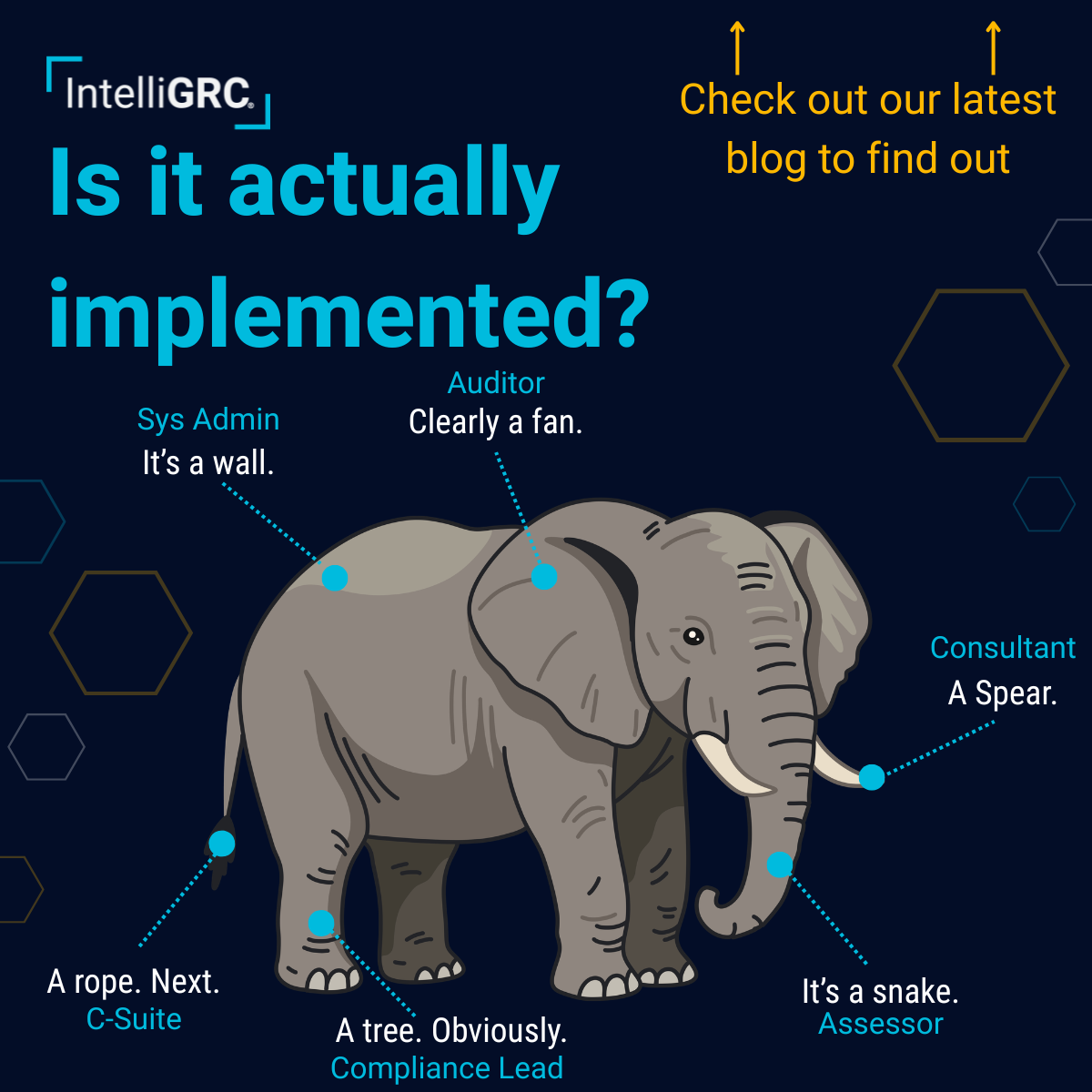
There’s an old parable, likely originating in ancient India and later immortalized in the West by John Godfrey Saxe’s poem, about six blind men who encounter an elephant for the first time. Each touches a different part and confidently declares what an elephant is. The trunk is a snake. The leg is a tree. The ear? Obviously, a fan. The tusk is a spear, the side is a wall, the tail is a rope. Each man thinks he’s right, each is entirely wrong, and, in most tellings, they all end up arguing despite touching the same elephant.
If you’ve spent any meaningful time in the GRC world, you already know where I’m going with this. The elephant is “implementation.” The blind men are all of us: assessors, auditors, consultants, sysadmins, compliance leads, and C-Suite executives, each grabbing a different part of the same framework and confidently declaring what we’ve found. I wrote a while back about assessor variance in CMMC and how the ecosystem’s reliance on professional judgment means two competent, well-intentioned assessors can look at the same evidence and reach different conclusions. And that phenomenon is not remotely unique to CMMC. Swap in an ISO 27001 certification auditor, a SOC 2 examiner, a PCI Qualified Security Assessor (QSA), or a HIPAA compliance reviewer and you’ll see lots of the same thing. That blog was about why the variance exists. However, this one is about what to do when you’re the one who has to make the call and the determination is a tad fuzzy.
I’ve struggled with this myself. In more than one consulting engagement, I’ve stared at a requirement that would be trivially easy to evaluate in a textbook or common environment and thought, “I really do not know whether this is implemented in this system.” Not because I didn’t understand the requirement, but because trying to fit the requirement into these particular circumstances wasn’t as clean as I’d previously enjoyed with other clients. The letter and the spirit of the law were pointing in different directions, and I was standing in the middle stroking the nice, full beard I so desperately wish I had.
So today, I want to reach past the assessment guides and FAQs and grab some older tools: epistemology, the branch of philosophy concerned with how we know what we know, and teleology, the study of purpose. The goal is a practical framework for judging whether a security requirement is actually implemented in a unique environment, and for building an argument that can survive contact with an assessor or auditor who may have grabbed a different part of the elephant. Whether your world is CMMC, ISO 27001, SOC 2, PCI DSS, or HIPAA, the tools travel. So, let’s ride this beast! (Actually, I’d probably never ride an elephant. SCARY!)
The Elephant in the Server Room: MFA and the Password Vault
I’m going to use a scenario to help convey these concepts. It comes from my corner of the woods, CMMC and NIST SP 800-171, but the pattern will feel familiar no matter whose assessment you’re preparing for. The 3.5.3 requirement (IA.L2-3.5.3 in CMMC terms) reads:
“Use multifactor authentication for local and network access to privileged accounts and for network access to non-privileged accounts.”
The assessment objectives break into four determinations: [a] privileged accounts are identified; [b] multifactor authentication is implemented for local access to privileged accounts; [c] multifactor authentication is implemented for network access to privileged accounts; and [d] multifactor authentication is implemented for network access to non-privileged accounts.
Now picture this environment. An organization has a local administrator account on a unique proprietary server. Rather than letting admins memorize or share that password, they’ve deployed a Privileged Access Management (PAM) solution. The PAM vaults the credential, rotates it automatically (often daily or even more frequently), and requires multifactor authentication before any human can retrieve it. Nobody knows the password. Nobody can know it for longer than a rotation window. To log on locally as that admin, you must first MFA into the PAM, check out the current password, and use it before it rotates away.
Here’s the dilemma. Objective [b] requires MFA be implemented for local access to the privileged account. Walk up to that server’s console and authenticate as the admin, and the operating system asks for exactly one factor: the password. At the moment of authentication, at the OS, there is no second factor. The letter of the law says the authentication to the account itself is what needs MFA, and by that reading, this is NOT MET.
But think about the risk 3.5.3 exists to mitigate: a single compromised factor should never be enough to seize a privileged account. In this environment, is it? To use that password, an attacker has to get it, and to get it, they would have to defeat MFA at the vault. The credential is random, rotated, checked out under logging, and, after rotation, unknown to every human on staff. The risk is mitigated. Arguably it’s mitigated better than in the shop that slapped a phishing susceptible MFA solution on the login screen and called it a day. Some assessors will accept this. Others might not. And both camps can point at the guide while doing it. So how do we think clearly here? Time to open the philosopher’s toolbox.
Tool #1: Correspondence, or “Show Me the Elephant”
The oldest and most intuitive theory of truth is the correspondence theory: a claim is true if and only if it corresponds to the way the world actually is. “The cat is on the mat” is true when the cat is, in fact, on the mat.
This is the assessor’s home turf, and rightly so. The claim under examination is the assessment objective itself: “multifactor authentication is implemented for local access to privileged accounts.” The correspondence test is beautifully simple. Go to the machine. Authenticate. Count the factors. In our PAM scenario, the count on the box is one, and the unnuanced claim of objective [b] being implemented fails to correspond to the observed world. Case closed?
Not so fast. Correspondence is only as good as the definitions underneath it. What, precisely, is “the authentication”? Is it the five seconds at the OS logon prompt, or the entire chain a human must traverse to get there: MFA to the vault, credential checkout, then logon? Define the authentication mechanism as the whole chain and the world you observe contains two (or more) factors after all, just not where you may have expected them. Correspondence can’t settle that definitional question for you; it only tells you to check your claims against reality once your terms are fixed. That unfixed term is exactly where assessor variance lives, and it’s why “just read the requirement” is not the mic drop people think it is.
Side Note: Whatever definition you adopt, correspondence still disciplines you: your SSP’s claims (or your policies) must match what an assessor will actually observe during the assessment. If your narrative says one thing and the login demonstration shows another, no amount of philosophy in the world is saving you and you’ll probably be faced with a bit of a rewrite!
Tool #2: Teleology, or “What Is This Requirement For?”
Aristotle taught that you don’t fully understand a thing until you understand its telos, its end or purpose. A knife’s telos is to cut; a good knife is one that cuts well. I’ve said it in nearly every deep-dive I’ve written: every security requirement exists to mitigate a specific risk. That risk is fundamental to the requirement’s telos, and it’s the most useful interpretive key you have when the letter gets ambiguous in a given scenario.
The telos of 3.5.3 [b] is not “make login screens display two prompts.” It’s this: no single compromised factor should ever be sufficient to wield a privileged account. Run the PAM scenario against that telos honestly. An attacker who steals “the password” has stolen a credential that expires at the next rotation and that could only be obtained by compromising the vault (which required MFA) or intercepting a checkout. The single-factor path to the account has been structurally removed for humans. The purpose of the requirement is served.
But (and this is a big ‘but’) teleological reasoning only really works when you do it with rigor rather than as a rationalization. A real teleological analysis forces you to enumerate the residual paths and potential defeaters: What about cached credentials on the box? The break-glass procedure? Can an admin check out the password and write it down? How fast does rotation actually occur after checkout, and is that verified? If you can’t answer those questions, you don’t really have a spirit-of-the-law argument and the excuses you give will probably sound like just that, excuses.
Tool #3: Coherence, or “The Whole Elephant”
Epistemologists offer a second major theory of justification: coherentism. On this view, a belief is justified by how well it fits into a consistent, mutually supporting web of other beliefs. Each claim is held up by everything around it.
This maps almost perfectly onto how assessments actually work. NIST SP 800-171A gives assessors three methods (Examine, Interview, Test) precisely because they are triangulating, checking whether your documentation, your people’s answers, and your systems’ observable behavior all tell the same story. That’s a coherence test. It’s hardly unique to the NIST world, either: an ISO 27001 auditor walks from your Statement of Applicability to your risk treatment plan to your operational records hunting for the same consistency. Every mature audit methodology is, at its core, ordered towards verifying coherence.
So ask yourself, “Does my MET claim for 3.5.3 cohere with the rest of my GRC program and system?” If your SSP says all privileged access flows through the PAM, but two admins casually mention in interviews that they RDP straight in with a password they’ve had memorized since 2023, your web just tore. If your least privilege story under 3.1.5 doesn’t mention PAM at all, if your audit logs under the 3.3.x family don’t capture checkouts, or if your diagrams don’t show the vault in the boundary, your elegant argument is sitting on top of an incoherent account of your own environment. Assessors can get behind an unconventional mechanism far more easily than a story that contradicts itself or is obviously incoherent.
Tool #4: Pragmatism, or “Poke the Elephant”
The American pragmatists, including Charles Sanders Peirce and William James, held that a belief’s meaning is tied to its conceivable practical consequences. James, and later Dewey, extended this to say that a belief’s truth or warrant depends on how well it works in experience. A belief that survives sustained, honest testing has earned something a merely asserted belief has not.
For our purposes, pragmatism translates to a wonderfully blunt instrument: stop speculating and poke it. Try to log on to that privileged account without touching the vault. Attempt a checkout without completing MFA. Pull the checkout logs and verify rotation actually happened. Have someone outside the implementation team attempt the bypass paths you identified and see if they can identify and exploit any other paths. If the protective effect survives adversarial poking, your claim now has evidence behind it rather than an implementation claim alone. Although there may still be differences in requirement interpretation and the suitability of some implementation approach, watching the same experiment produce the same result is certainly a key part of finding agreement.
More Elephants in the Room
Lest you think this is all about one MFA edge case, the same pattern shows up everywhere. The tools of reason are helpful across the board! And, interestingly, different frameworks have staked out very different positions on how much room the spirit-of-the-law argument gets.
FIPS-validated cryptography (3.13.11): the closed gap. The spirit is “CUI is protected by cryptography strong enough to trust.” The letter is “the cryptographic module is CMVP-validated and running in FIPS mode.” Here’s the thing: this is a case where the interpretive gap has been incredibly minimized. DFARS 252.204-7012 and NIST SP 800-171 Rev 2 (and presumably the DoD’s ODPs for Rev 3) have explicitly adjudicated the letter and reduced the flexibility around encryption standards for CUI. I wrote about the painful practical fallout in Temporarily Deficient: A Common SC.L2 3.13.11 Concern. The epistemic lesson: part of wisdom is knowing where argument space exists and where there is no room for variance. Teleology is a tool for genuine ambiguity, not a solvent for clear requirements that might be incredibly inconvenient.
HIPAA’s “addressable” specifications: teleology codified. On the other end of the spectrum, the HIPAA Security Rule builds the spirit-of-the-law analysis into the letter itself. Encryption of ePHI, for example, is an addressable implementation specification: a covered entity must assess whether it is reasonable and appropriate in its environment and, if not, document why and implement an equivalent alternative that achieves the same purpose. That’s a teleological argument with some regulatory flexibility built into the requirement.
Side note: As I mentioned in my blog on the HIPAA Security Rule’s NPRM, there are some substantial changes to HIPAA that seem to be coming, this topic being one of them. The Proposed Rule to revise the HIPAA Regulations (in its current form) will eliminate the distinction between “required” and “addressable” specifications so definitely keep that in mind for the future.
PCI DSS and the Customized Approach: a formal lane for the spirit. PCI DSS v4 went a step further and institutionalized the whole debate. Alongside the traditional defined approach, an entity can meet a requirement’s stated Customized Approach Objective through a different mechanism, provided it performs a targeted risk analysis, documents the control, and lets the QSA test it. That is, almost verbatim, the process this blog describes: name the telos, prove your mechanism serves it, and show your work. The framework’s authors saw the letter-versus-spirit concept and built a prudent approach for resolution into the framework itself.
SOC 2’s principles-based criteria: almost all spirit. The Trust Services Criteria sit at the far end: broad statements like “the entity restricts logical access” with points of focus that are explicitly not mandatory. There’s comparatively little letter to argue about, so practitioner and auditor judgment carry nearly everything, and your documented rationale effectively is the implementation. If you’ve ever wondered why two SOC 2 reports for similar companies look so different, this is why. It’s important for organizations to really understand their risks, the Trust Services Criteria, risk management, and, I would argue, teleological principles to reverse engineer solid controls to meet those needs well.
Physical protection in a fully remote company (3.10.1 and friends). The letter of the Physical Protection family presumes a facility: escort visitors, log physical access, control access devices. Now hand that to a ten-person, cloud-only shop where CUI never leaves a hardened enclave and there is no office at all. The telos is preventing unauthorized physical access to systems and media that contain CUI. A rigorous spirit-based implementation addresses home office expectations, screen privacy, etc. while acknowledging that the risk these particular requirements exist to mitigate doesn’t exist for this type of organization in the same way that it does in other organizations with physical facilities in scope. This organization heavily leans on the data center controls inherited from the cloud provider. Most assessors will accept a well-documented rationale here. There may be other similar situations where applicability is fuzzy, and you can use the same teleological considerations to help drive your implementations and arguments for them as well!
One thing to keep in mind is that there may very well be situations where implementing the requirements or security controls may simply just not be feasible for the system. This is when you’ll want to stop spending time thinking about the epistemic concerns and spirit vs. letter paradigm and start considering actual variance or alternative measures for mitigating risk which I address in another blog found here: Chesterton’s Fence and the Controls You Wish Weren’t There.
Building the Defensible Argument
When you conclude that a requirement is implemented in spirit through an unconventional mechanism, here’s how to build the case.
Pointer #1: Anchor everything to the unit your framework actually assesses. For NIST SP 800-171, that’s the assessment objectives, not the requirement’s summary sentence. For PCI DSS, the testing procedures (or the Customized Approach Objective). For SOC 2, the criteria. For HIPAA, the implementation specifications. Write your implementation claim against each of those units explicitly. For our PAM example, that means directly addressing 3.5.3’s objective [b] rather than hoping the assessor stays at the level of the general requirement.
Pointer #2: Name the telos out loud. State, where appropriate, like in your SSP and policies, the risk the requirement mitigates and how your mechanism defeats each attack path that risk implies. Be ready to defend your implementation’s coverage of residual paths you identified. An argument that acknowledges these potential concerns is dramatically more credible than one that pretends it has none.
Pointer #3: Steelman the strict reading. When the scrutiny comes up, be ready to say it plainly: “At the OS logon event, a single factor is presented. We understand the strict reading of objective [b], and here is why we assess the authentication mechanism as the full chain.” An organization that has clearly wrestled with the counterargument comes across as diligent. One that seems unaware of it gets read as confused or inconsiderate.
Pointer #4: Make the web coherent before anyone else inspects it. Sweep the related requirements (least privilege, audit logging, remote access, maintenance) and your documentation so the whole environment tells one consistent story in which your mechanism is a load-bearing, well-integrated part.
Pointer #5: Test it and keep the artifacts. Pragmatism, remember? Bypass attempts, checkout logs, rotation verification, screenshots. Evidence of adversarial testing converts a philosophical position into an empirical one. At the very least be ready to demonstrate it live.
Pointer #6: Write the rationale before the assessment, not during it. A documented implementation rationale (we at IntelliGRC sometimes call it an assessment playbook / cheat sheet) drafted in advance carries far more weight than an explanation improvised on Day 2 while an assessor waits. It also proves the reasoning predated the scrutiny.
Pointer #7: Ask early and plan for the “no.” Consider raising the interpretation with your C3PAO, QSA, or audit firm during readiness conversations rather than springing it mid-assessment. And have a fallback: know what it would take to satisfy the strict letter (say, an OS-level MFA agent on those endpoints), what it would cost, and how fast you could execute if the judgment goes against you. A defensible argument plus a ready Plan B is a position of strength.
Side Note: In many ecosystems, CMMC especially, assessors are not allowed to give guidance or feedback (e.g., consulting) as this could be a massive conflict of interest. QSAs in the PCI world have a bit more latitude, but either way, be ready to get pretty blunt answers (or maybe even no answer at all).
Pointer #8: Keep your epistemic humility. You might be wrong. The assessor might be wrong. The entire apparatus of assessment methods, quality reviews, and appeals exists precisely because human judgment is fallible, which was the whole point of the assessor variance blog. The goal is not to win an argument. The goal is to actually know, as well as knowing can be done, whether the risk is mitigated, and to show your work.
Stepping Back from the Elephant: Final Thoughts
Here’s the thing about the six blind men: their real handicap was epistemic ignorance. Each mistook one method of inquiry for the whole of knowledge and stopped investigating. The checker who only counts factors at the login prompt, the teleologist who waves away the letter because “the risk is handled,” the reviewer who never touches a keyboard, and the tester who never reads the SSP are all grabbing one part of the same animal.
Used together, though, the tools discipline each other. Correspondence keeps you honest about what’s observably true. Teleology keeps you focused on why any of it matters. Coherence keeps your story consistent. Pragmatism makes you prove it. Run a hard implementation question through all four, in good faith, and you’ll land somewhere far more defensible than “well, our last consultant said it was fine.”
If you’re staring down one of these letter-versus-spirit judgment calls, whether you’re an OSC preparing for your C3PAO assessment, an MSP making these calls for clients, an organization juggling multiple frameworks at once, or a consultant standing in that same intersection I know so well, we at IntelliGRC would love to help you think it through. Feel free to fill out our contact form found here or shoot us an email at [email protected].
As always, Happy Implementing!
— Steven Molter
Connect with me on LinkedIn if you want to keep the conversation going!
Key Takeaways
- Determining whether a security requirement is actually implemented in a unique environment is often a judgment call, and assessor variance means honest experts can disagree about the same evidence, in CMMC and in every other framework.
- Four epistemic tools discipline that judgment: correspondence (does the claim match observable reality?), teleology (is the risk the requirement exists to mitigate actually mitigated?), coherence (does the claim fit consistently with your whole documented and operational environment?), and pragmatism (does the protection survive adversarial testing?).
- The 3.5.3 PAM scenario shows how a mechanism can satisfy the spirit of a requirement while arguably missing its letter, and why defining the boundaries of “the authentication mechanism” is where the real disagreement lives.
- Frameworks sit on a spectrum: some deliberately close the interpretive gap (FIPS-validated cryptography), some codify the spirit-of-the-law analysis (HIPAA’s addressable specifications, PCI DSS’s Customized Approach), and some are nearly all judgment (SOC 2’s criteria). Know which kind of terrain you’re standing on before you argue.
- A defensible position names the telos, steelmans the strict reading, coheres with the rest of your program, is backed by test evidence, is written down in advance, and comes with a ready fallback plan.